Guide · Food safety
AI in food safety
What four federal bureaus with food safety or inspection duties, at the FDA and USDA, say they use AI for, how far along each use is, and what the FDA's own plans say. One of the four, USDA's Marketing and Regulatory Programs, is mostly animal and plant health. Counted from the public record.
Where food safety sits in the inventory
Federal food safety is split between two departments. The FDA's Human Foods Program "oversees all Food and Drug Administration (FDA) activities related to food safety and nutrition", including "food related inspections and investigations".[4] Meat and poultry are USDA's side: its Food Safety rows speak of a meat and poultry hotline, poultry slaughter lines and export certification for the meat industry.[1] OMB's 2025 inventory of federal AI use cases, 3,611 rows in all, names the bureau responsible for each one, and that column is how this page finds the food safety work.[1][2]
The column names USDA's mission areas rather than its agencies. Rows under "Food Safety" name the Food Safety and Inspection Service in their text; rows under "Marketing and Regulatory Programs" name the Animal and Plant Health Inspection Service and its National Wildlife Research Center; no row names the Agricultural Marketing Service.[1] On the FDA side the column goes down to the center or office, so the Human Foods Program (HHS/FDA/HFP) and the office labelled HHS/FDA/OII, whose rows cover imports, filer evaluation and field video, can be counted on their own.[1]
How many
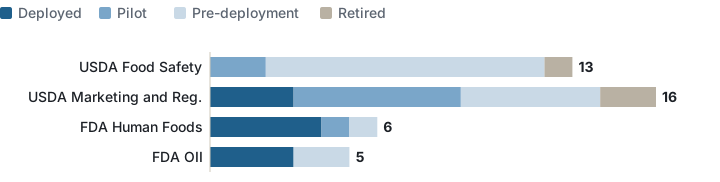
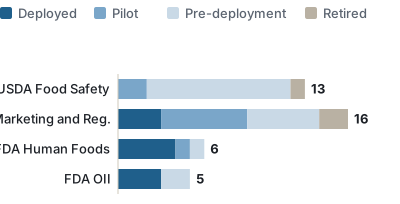
Those four bureaus with food safety or inspection duties list 40 use cases between them: 13 under USDA Food Safety, 16 under Marketing and Regulatory Programs, 6 in the Human Foods Program and 5 in OII; the Marketing and Regulatory Programs rows are mostly animal and plant health, as the next section shows.[1] That is 1% of the inventory. Only 10 of the 40 are marked deployed and 18 are still before deployment.[1]
| Bureau as the file names it | Listed | Deployed | Pilot | Pre-deployment | Retired | High-impact |
|---|---|---|---|---|---|---|
| USDA: Food Safety | 13 | 0 | 2 | 10 | 1 | 0 |
| USDA: Marketing and Regulatory Programs | 16 | 3 | 6 | 5 | 2 | 0 |
| HHS: HHS/FDA/HFP | 6 | 4 | 1 | 1 | 0 | 0 |
| HHS: HHS/FDA/OII | 5 | 3 | 0 | 2 | 0 | 0 |
| The four together | 40 | 10 | 9 | 18 | 3 | 0 |
| USDA, all bureaus | 162 | 39 | 47 | 57 | 19 | 4 |
| HHS, all bureaus | 447 | 167 | 88 | 143 | 49 | 2 |
The two sides are at different stages. The Human Foods Program has 4 of its 6 deployed, among them the "Warp Intelligent Learning Engine (WILEE)" with an operational date the file gives as "Mar-23".[1] USDA Food Safety has none deployed: 2 pilots, 10 before deployment and 1 retired.[1] None of the 40 is marked high-impact; 2 at OII were presumed high-impact and then determined not to be.[1]
Data: food-safety-bureaus-by-stage-2025.csv · usda-by-mission-area-2025.csv
What the uses are for
The file gives each use case a name and a problem it solves. In the Human Foods Program the deployed ones are the "Food AI Decision Engine (FAIDE)", whose stated problem is to "Prioritize limited regulatory resources and maximize public health protection"; the "Rapid Intuitive Pathogen Surveillance (RIPS)", to "Identify and prioritize incoming sources of potential foodborne outbreaks, maximizing public health by reducing the time burden on regulators"; the "Warp Intelligent Learning Engine (WILEE)", which reads scientific publications for chemical signals; and the "Product Label and Text Extraction System (PLATES)", which extracts food label data.[1]
USDA Food Safety's list is a list of plans. Of its 13 rows, 8 are labelled generative AI, among them an "LLM-Powered Drafting Assistant for NRs and MOIs", which "Supports inspectors in drafting Noncompliance Records (NRs) and Memorandums of Interview (MOIs)", and a "Chatbot for Meat and Poultry Hotline & OPACE Efficiency".[1] The one computer-vision row, "AI Camera Technology to identify Product Safety Concerns", describes "Business operations with camera technology to detect food safety issues in poultry slaughter lines".[1] Two pilots are science: "Genomic Analyses of Pathogen Subtypes" and "Foodborne Illness Source Attribution", the latter a joint CDC, FDA and FSIS effort to predict the likely food sources of illness.[1]
Marketing and Regulatory Programs is mostly animal and plant health rather than food safety as such: 6 of its 16 rows are National Wildlife Research Center projects on rabies, genetics and birds, and a "Predictive Modeling of Invasive Pest Species" is before deployment.[1] OII's deployed rows include "Filer Evaluation prioritization using risk-based decision Machine Learning approach", a risk score for what the row calls "over 4,000 filers in the current FDA inventory", and a translation service for documents on articles offered for import.[1]
| Use case | Bureau | Stage | Type of AI |
|---|---|---|---|
| Multilingual Translation of Recalls and Public Health Alerts | Food Safety | Retired | (no classification given) |
| Genomic Analyses of Pathogen Subtypes | Food Safety | Pilot | Classical ML |
| Foodborne Illness Source Attribution | Food Safety | Pilot | Classical ML |
| HR Chatbot | Food Safety | Pre-deployment | Generative AI |
| AR-Enabled Mobile App for Policy and Regulation Review | Food Safety | Pre-deployment | Generative AI |
| LLM-Powered Drafting Assistant for NRs and MOIs | Food Safety | Pre-deployment | Generative AI |
| Chatbot for Meat and Poultry Hotline & OPACE Efficiency | Food Safety | Pre-deployment | Generative AI |
| AI-Enhanced Qlik Reporting for FSIS Data | Food Safety | Pre-deployment | Generative AI |
| Consumer Mobile App for Identifying Recalled Products | Food Safety | Pre-deployment | NLP |
| AI Camera Technology to identify Product Safety Concerns | Food Safety | Pre-deployment | Computer Vision |
| Automating ATO/POAM documentation | Food Safety | Pre-deployment | Generative AI |
| Incident Detection and Response Acceleration | Food Safety | Pre-deployment | Generative AI |
| PHIS Export Library Assistant | Food Safety | Pre-deployment | Generative AI |
| Food AI Decision Engine (FAIDE) | HHS/FDA/HFP | Deployed | Classical ML |
| Warp Intelligent Learning Engine (WILEE) | HHS/FDA/HFP | Deployed | Classical ML |
| Rapid Intuitive Pathogen Surveillance (RIPS) | HHS/FDA/HFP | Deployed | Classical ML |
| AI-Powered Assistant for Pathogen Detection (AIPD) | HHS/FDA/HFP | Pre-deployment | Generative AI |
| Product Label and Text Extraction System (PLATES) | HHS/FDA/HFP | Deployed | Classical ML |
| Data Ingestion and Content Explorer (DICE) | HHS/FDA/HFP | Pilot | Classical ML |
Data: food-safety-use-cases-2025.csv (every row of the four bureaus, with the problem each says it solves)
Across the FDA
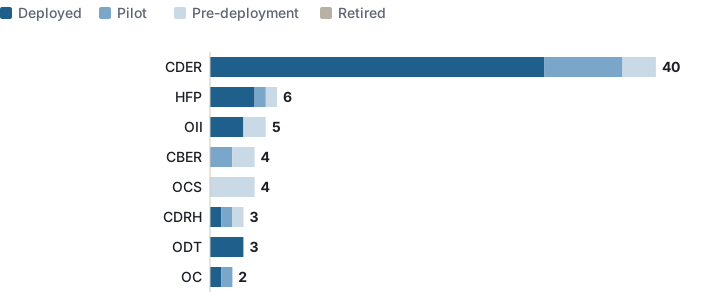
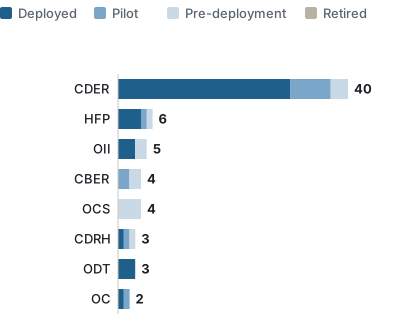
The Human Foods Program is a small part of the FDA's AI list. The FDA's 67 use cases sit in 8 centers and offices, led by the Center for Drug Evaluation and Research with 40, of which 30 are deployed.[1] Across the whole FDA, 42 of 67 are deployed and none is retired.[1]
One of the two rows under the Office of the Commissioner is the "Elsa GenAI Chat Tool", the agency-wide generative AI tool the FDA announced on 2 June 2025. The FDA said then that it was already using Elsa to "identify high-priority inspection targets" and that its models "do not train on data submitted by regulated industry".[7] The file marks it deployed, with an operational date of "Jun-25".[1]
Data: fda-by-center-2025.csv · examples-2025.csv
Food elsewhere in the file
A bureau count misses food safety work filed under other bureaus. Searching every use case's name, problem and benefits for the words food, foods, foodborne, meat, poultry or slaughter finds 25 rows, 14 of them in the four bureaus above and 11 elsewhere.[1] Among the others: CDC's "1CDP (SEDRIC) AIP for Advanced Foodborne Outbreak Investigation (AI Summarization and Receipt Reading)", deployed, which supports multi-state outbreak investigations; Customs and Border Protection's "Agriculture Commodity Model (AGC)", deployed, which scores inbound cargo for agricultural pest risk; and two NASA rows before deployment, "Planted Area mapping in food insecure conflict zones" at Goddard Space Flight Center and "Large language models for food security outlooks" at Marshall Space Flight Center.[1]
| Agency | Rows | Deployed | In the four bureaus |
|---|---|---|---|
| Department of Health and Human Services | 10 | 6 | 6 |
| Department of Agriculture | 9 | 2 | 8 |
| Department of the Interior | 3 | 1 | 0 |
| National Aeronautics and Space Administration | 2 | 0 | 0 |
| Department of Homeland Security | 1 | 1 | 0 |
Data: food-mentions-by-agency-2025.csv · food-mentions-2025.csv
The FDA's plans and rules
The FDA's New Era of Smarter Food Safety Blueprint sets out "the approach FDA will take over the next decade" under four core elements: tech-enabled traceability, smarter tools and approaches for prevention and outbreak response, new business models and retail modernization, and food safety culture.[5] Its goal 2.2 is to "Advance FDA's predictive analytics capabilities through expanded use of artificial intelligence" and machine learning, starting from the agency's proof of concept on AI screening of imported foods at ports of entry.[5] It also proposes to "Explore using artificial intelligence to mine nontraditional sources of information", naming customer online reviews, medication sales trends and dining apps, to detect outbreaks.[5]
The traceability element became a rule. The Food Traceability Rule, under Section 204(d) of the Food Safety Modernization Act, requires firms that manufacture, process, pack or hold foods on the Food Traceability List to keep records of key data elements for critical tracking events and to give them to the FDA within 24 hours or an agreed time.[6] The original compliance date was 20 January 2026; the FDA proposed a 30-month extension to 20 July 2028, and the FDA says the Continuing Appropriations, Agriculture, Legislative Branch, Military Construction and Veterans Affairs, and Extensions Act of 2026 directed it not to enforce the rule before that date, which it intends to follow.[6]
The earlier version of this site ran 69 posts in its food category, on inspection, traceability, sorting, grading, allergen and fraud detection, packaging, shelf life, supply chains and demand forecasting; 34 of them fold into this page, 8 into AI in agriculture, and the other 27 are not brought back.[8] Data: old-food-posts-by-disposition.csv
Counting caveats
- Agencies report on themselves, and each chose the stage, topic, type of AI and high-impact label for its own rows.[2]
- The bureau column is as the agency wrote it. USDA's mission-area names mean the Food Safety and Inspection Service cannot be told apart from the rest of its mission area, and nothing in the file names the Agricultural Marketing Service.[1]
- The word search finds what the agencies wrote, not what the systems do; a use case about produce or seafood that avoids those words is missed, and a row about food security is caught.[1]
- The inventory leaves out AI in national security systems, AI used for basic or applied research, and Department of War use cases (the Department of Defense, under the name OMB's file uses); common tasks done with off-the-shelf products go in a separate consolidated file.[3]
- USDA's own pages on AI were not consulted for this page; the record used for the USDA counts is OMB's file alone.
See also: AI in the public sector for the whole inventory, Generative AI in government, Data science in government, and the data story 3,611 uses of AI on the federal list.
Sources
- Office of Management and Budget, 2025 Federal Agency AI Use Case Inventory, file of individually reported use cases (3,611 rows; the repository says "as of April 13, 2026"), counted by this site: 2025_individually_reported_AI_use_cases.csv. Read 28 October 2026.
- Office of Management and Budget, 2025 inventory data dictionary. Read 28 October 2026.
- Office of Management and Budget, 2025 Federal Agency AI Use Case Inventory repository, README (summary, submission schedule and exclusion criteria). Read 28 October 2026.
- U.S. Food and Drug Administration, Human Foods Program organization page (page marked "content current as of" 1 October 2026). Read 29 October 2026.
- U.S. Food and Drug Administration, New Era of Smarter Food Safety Blueprint (page marked "content current as of" 5 March 2024). Read 29 October 2026.
- U.S. Food and Drug Administration, FSMA Final Rule on Requirements for Additional Traceability Records for Certain Foods (page marked "content current as of" 8 October 2026). Read 29 October 2026.
- U.S. Food and Drug Administration, news release, FDA Launches Agency-Wide AI Tool to Optimize Performance for the American People, 2 June 2025. Read 29 October 2026.
- The publisher's own copy of the earlier site, made on 23 August 2026 (312 post folders, posts dated February 2024 to September 2025); not public. Read 28 October 2026.
How this page was counted: one row per use case in OMB's file, read on 28 October 2026, selected by exact values of the agency and agency_bureau columns (USDA "Food Safety", USDA "Marketing and Regulatory Programs", HHS "HHS/FDA/HFP", HHS "HHS/FDA/OII"), then counted by development_stage and is_high_impact; FDA rows grouped by agency_bureau; and a whole-word, any-case search of use_case_name, problem_solved and benefits for food, foods, foodborne, meat, poultry and slaughter. Blanks are counted as "no stage given", "no topic given" or "no classification given". The CSV files beside this page carry the counts, the rules in README.txt, the source address and the read date.