Guide · The public sector
AI in the public sector
What the federal government says it uses AI for, how far along each use is, and the rules agencies work under. Built from the public inventory, not from vendor claims.
The public record
The yearly inventory goes back to Executive Order 13960, signed on 3 December 2020.[4] OMB's repository says the 2025 inventory follows Section 5 of that order, the Advancing American AI Act and OMB Memorandum M-25-21, and OMB compiled the agencies' lists into that one public repository.[2]
Agencies sent their 2025 lists to OMB by 22 December 2025 and had to publish them by 28 January 2026.[2]
The 2025 count
The 2025 inventory holds 3,611 individually reported use cases from 41 agency submissions; two more agencies reported that they use no AI.[2] By the stage each agency gave:[1]
| Stage | Use cases |
|---|---|
| Deployed | 1,040 |
| Pilot | 440 |
| Pre-deployment | 1,479 |
| Retired | 314 |
| (no stage given) | 338 |
So 29% are marked deployed and 41% are still before deployment.[1] OMB's own summary table shows 1,818 as deployed and piloted; counting the stage column gives 1,480, and the gap is the 338 rows that carry no stage.[2][1]
Agencies marked 445 use cases as high-impact, OMB's term for AI whose output serves as a principal basis for decisions or actions with a legal, material, binding or significant effect on rights or safety.[2][6]
Data: use-cases-by-stage-2025.csv
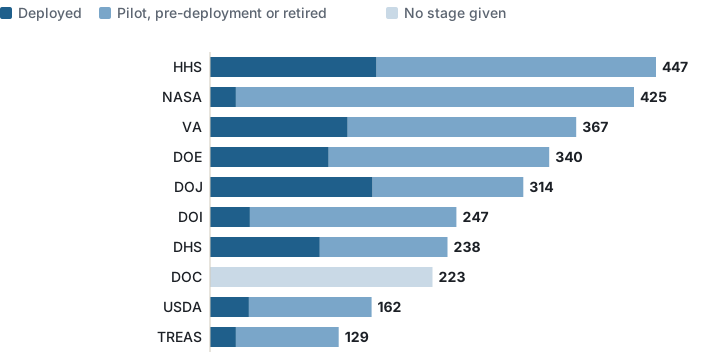
Who lists the most
| Agency | Listed | Deployed | No stage given |
|---|---|---|---|
| Department of Health and Human Services (HHS) | 447 | 167 | 0 |
| National Aeronautics and Space Administration (NASA) | 425 | 26 | 0 |
| Department of Veterans Affairs (VA) | 367 | 138 | 0 |
| Department of Energy (DOE) | 340 | 119 | 0 |
| Department of Justice (DOJ) | 314 | 163 | 0 |
| Department of the Interior (DOI) | 247 | 40 | 0 |
| Department of Homeland Security (DHS) | 238 | 110 | 0 |
| Department of Commerce (DOC) | 223 | 0 | 223 |
| Department of Agriculture (USDA) | 162 | 39 | 0 |
| Department of the Treasury (TREAS) | 129 | 26 | 0 |
Three agencies sent lists without a stage column: Commerce with 223 rows, and the Tennessee Valley Authority and the Department of Education, which are outside the ten above.[1] Their uses are counted in every total but not in any stage.
What it is used for
Each use case is filed under a topic. The largest are science with 758, administrative functions with 424, IT with 394, law enforcement with 285 and health and medical with 272; 603 carry no topic.[1]
Data: use-cases-by-topic-2025.csv
The rules agencies work under
OMB's Memorandum M-25-21 of 3 April 2025 opens by citing Executive Order 14179, signed on 23 January 2025, and sets out what agencies must do:[6][5]
- each agency names a Chief AI Officer within 60 days;[6]
- each CFO Act agency convenes an AI governance board within 90 days and publishes an AI strategy within 180 days;[6]
- agencies apply minimum risk management practices to high-impact AI.[6]
M-25-22, issued the same day, covers buying AI.[7] Executive orders on AI signed since then include 14319, Preventing Woke AI in the Federal Government (23 July 2025); 14365, Ensuring a National Policy Framework for Artificial Intelligence (11 December 2025); 14409, Promoting Advanced Artificial Intelligence Innovation and Security (2 June 2026); and 14434, Inaugurating the Era of Super Intelligence (29 September 2026).[8]
Safeguards and rights
The earlier version of this site ran general essays on AI and human rights. The public-sector version of that question is narrower and checkable: for each high-impact use, the inventory has columns on pre-deployment testing, impact assessment, independent review, ongoing monitoring, staff training, fail-safes, an appeal process and public consultation.[3] Those columns are where to look before trusting a claim that a federal system is safe or fair, and they are filled in by the agencies themselves.
What the inventory leaves out
Out of scope: AI in national security systems and the intelligence community, AI used for basic or applied research, Department of War use cases, and use cases whose release would conflict with law or policy. Common tasks done with off-the-shelf commercial products go in a separate consolidated file.[2]
See also: Generative AI in government, Data science in government, and the data story 3,611 uses of AI on the federal list.
Sources
- Office of Management and Budget, 2025 Federal Agency AI Use Case Inventory, file of individually reported use cases (3,611 rows; the repository says "as of April 13, 2026"), counted by this site: 2025_individually_reported_AI_use_cases.csv. Read 28 October 2026.
- Office of Management and Budget, 2025 Federal Agency AI Use Case Inventory repository, README (summary, submission schedule and exclusion criteria). Read 28 October 2026.
- Office of Management and Budget, 2025 inventory data dictionary. Read 28 October 2026.
- Federal Register, Executive Order 13960, Promoting the Use of Trustworthy Artificial Intelligence in the Federal Government, signed 3 December 2020. Read 28 October 2026.
- Federal Register, Executive Order 14179, Removing Barriers to American Leadership in Artificial Intelligence, signed 23 January 2025. Read 28 October 2026.
- OMB Memorandum M-25-21, Accelerating Federal Use of AI through Innovation, Governance, and Public Trust, 3 April 2025. Read 28 October 2026.
- OMB Memorandum M-25-22, Driving Efficient Acquisition of Artificial Intelligence in Government, 3 April 2025. Read 28 October 2026.
- Federal Register, executive orders whose titles name artificial intelligence, from the Federal Register API; each order links to its own page in the list above. Read 28 October 2026.
How this page was counted: one row per use case in OMB's file, by the development_stage, agency and topic_area columns, read on 28 October 2026. The CSV files beside this page carry the counts, the source address and the read date.