Guide · Agriculture
AI in agriculture
What the Department of Agriculture says it uses AI for, which of its bureaus list it, how far along each use is, and what the department's own plan and its inspector general say about it. Counted from the public inventory.
The public record
Federal agencies list their AI use cases each year and OMB compiles the lists into one public file.[3] The Department of Agriculture appears in that file as "USDA", and this guide counts its rows.[1] The department's own inventory page, which now calls the subject "super intelligence", links to a CSV "updated January 2026" that carries the same 162 use cases with the same stages as OMB's file.[4][5][1]
USDA reports each use case under a mission area or staff office, not under an individual agency, so the Forest Service, the Natural Resources Conservation Service, the Agricultural Research Service and the National Agricultural Statistics Service are found by the bureau they belong to and, where the agency named its tool, by the use case's name.[1]
How many
USDA lists 162 of the 3,611 use cases in the 2025 inventory.[1] Of those, 39 are marked deployed, 47 are pilots, 57 are before deployment and 19 are retired; every row carries a stage.[1] So 24% of USDA's list is deployed, against 29% for the whole file.[1]
| Agency | Deployed | Pilot | Pre-deployment | Retired | No stage given | Total |
|---|---|---|---|---|---|---|
| USDA | 39 | 47 | 57 | 19 | 0 | 162 |
| All 3,611 use cases | 1,040 | 440 | 1,479 | 314 | 338 | 3,611 |
Data: usda-by-stage-2025.csv
Which bureaus
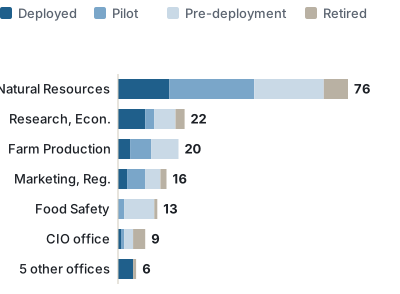
Natural Resources and Environment, the mission area that holds the Forest Service, lists 76 of the 162, with 17 deployed and 28 in pilot.[1] Research, Education and Economics lists 22 with 9 deployed; Farm Production and Conservation 20; Marketing and Regulatory Programs 16; Food Safety 13, none of them deployed; and the Office of the Chief Information Officer 9, of which 4 are retired.[1] The other 5 offices list 6 between them.[1]
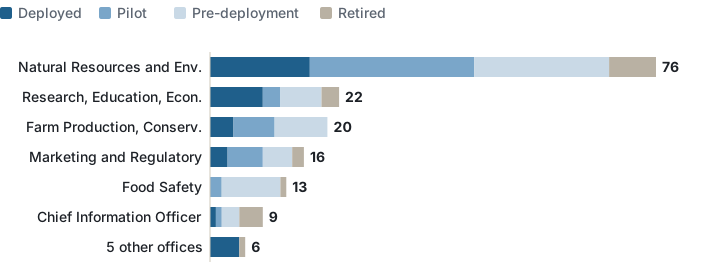
| Bureau, as named in the file | Deployed | Pilot | Pre-deployment | Retired | Total | High-impact |
|---|---|---|---|---|---|---|
| Natural Resources and Environment | 17 | 28 | 23 | 8 | 76 | 0 |
| Research, Education and Economics | 9 | 3 | 7 | 3 | 22 | 0 |
| Farm Production and Conservation | 4 | 7 | 9 | 0 | 20 | 3 |
| Marketing and Regulatory Programs | 3 | 6 | 5 | 2 | 16 | 0 |
| Food Safety | 0 | 2 | 10 | 1 | 13 | 0 |
| Office of the Chief Information Officer | 1 | 1 | 3 | 4 | 9 | 0 |
| Food, Nutrition, and Consumer Services | 1 | 0 | 0 | 1 | 2 | 0 |
| Departmental Administration | 1 | 0 | 0 | 0 | 1 | 0 |
| Office Of Homeland Security | 1 | 0 | 0 | 0 | 1 | 0 |
| Office of Safety, Security, and Protection | 1 | 0 | 0 | 0 | 1 | 1 |
| Research, Education and Economics; Farm Production and Conservation | 1 | 0 | 0 | 0 | 1 | 0 |
What it is for
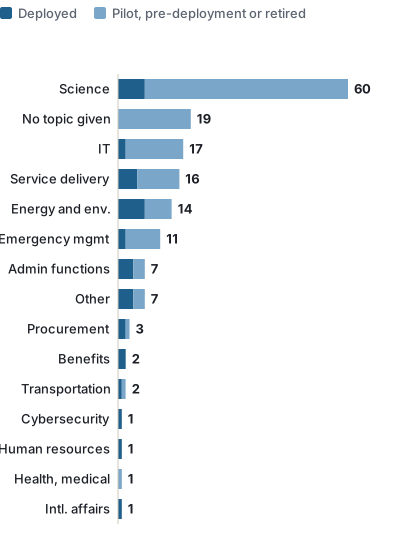
Science is the largest topic, with 60 use cases, of which 7 are deployed.[1] Then come IT with 17, service delivery with 16, energy and environment with 14 and emergency management with 11; 19 rows, the retired ones, carry no topic.[1][2]
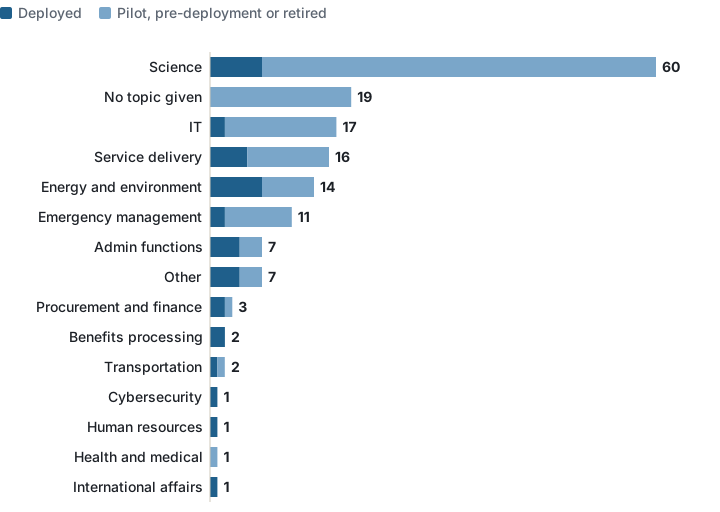
The names say what the science is. Under Natural Resources and Environment the deployed rows include "Landscape Change Monitoring System (LCMS)", "TreeMap and FuelMap (all versions)", "LANDFIRE", "Predictive flood modeling" and "BirdNET to detect bird vocalizations for research and species monitoring", and the pilots include forest health detection, wildfire severity and fire containment models.[1] Under Research, Education and Economics the deployed rows include "Cropland Data Layer", "Predictive Cropland Data Layer", "County-Level Remotely-Sensed Corn and Soybean Yield Estimation", "Survey Outlier Detection Model" and "NAL Automated Indexing".[1] Farm Production and Conservation's deployed rows are "Operational Water Supply Forecasting for Western US Rivers", "Dam Inspection Report Document Processing", "GIS Invasive Tree Extraction for Field Level Users" and a loan-document reader, "ROE Document Recognition - RoeDR".[1] Food Safety's 10 pre-deployment rows are mostly filed under IT and include chatbots, a drafting assistant and reporting tools.[1]
| Bureau | Use case, as named in the file | Topic | Type of AI |
|---|---|---|---|
| Departmental Administration | ProcureSight | Procurement and financial management | Generative AI |
| Farm Production and Conservation | Dam Inspection Report Document Processing | Administrative functions | Computer vision |
| Farm Production and Conservation | GIS Invasive Tree Extraction for Field Level Users | Energy and Environment | Computer vision |
| Farm Production and Conservation | Operational Water Supply Forecasting for Western US Rivers | Service Delivery | Classical ML |
| Farm Production and Conservation | ROE Document Recognition - RoeDR | Benefits Processing | Natural language processing (NLP) |
| Food, Nutrition, and Consumer Services | Nutrition Education & Local Access Dashboard | Benefits Processing | Classical ML |
| Marketing and Regulatory Programs | Approximate String Matching (aka fuzzy matching) to Standardize Data | Service Delivery | Natural language processing (NLP) |
| Marketing and Regulatory Programs | Automated PDF Document Processing and Information Extraction | Administrative functions | Natural language processing (NLP) |
| Marketing and Regulatory Programs | US Poultry and Operations Dataset | Emergency management | Classical ML |
| Natural Resources and Environment | AI for regional forest mapping and monitoring | Energy and Environment | Classical ML |
| Natural Resources and Environment | BirdNET to detect bird vocalizations for research and species monitoring | Energy and Environment | Classical ML |
| Natural Resources and Environment | DISTRIB-II: Habitat Suitability of Eastern United States Tree | Science | Classical ML |
| Natural Resources and Environment | Ecosystem Management Decision Support System (EMDS) | Energy and Environment | Classical ML |
| Natural Resources and Environment | Esri ArcGIS Pro Deep Learning Modules | Science | Classical ML |
| Natural Resources and Environment | Forest Plan review and planning support | IT | Generative AI |
| Natural Resources and Environment | Infosec Chatbot | Cybersecurity | Generative AI |
| Natural Resources and Environment | LANDFIRE | Emergency management | Classical ML |
| Natural Resources and Environment | Landscape Change Monitoring System (LCMS) | Science | Classical ML |
| Natural Resources and Environment | NRE FS Customer Relationship Manager New Hire Experience (NRE FS CRM NHE) CSAM ID 2639 | Human resources | Generative AI |
| Natural Resources and Environment | Policy Analysis | Other | Classical ML |
| Natural Resources and Environment | Predictive flood modeling | Transportation | Classical ML |
| Natural Resources and Environment | Recreation One Stop use of AI | Service Delivery | Generative AI |
| Natural Resources and Environment | The Big Data, Mapping, and Analytics Platform (BIGMAP) Project | Science | Classical ML |
| Natural Resources and Environment | TreeMap and FuelMap (all versions) | Science | Classical ML |
| Natural Resources and Environment | TreeSearch | Energy and Environment | Generative AI |
| Natural Resources and Environment | Turbo plan | Energy and Environment | Generative AI |
| Office Of Homeland Security | ARGUS AI Supply Chain Interference | International Affairs | Agentic AI |
| Office of Safety, Security, and Protection | Video Surveillance System | Administrative functions | Computer vision |
| Office of the Chief Information Officer | Chatbot for IT Customer Help Desk | IT | Generative AI |
| Research, Education and Economics | Census of Agriculture Propensity Scores via Machne Learning | Service Delivery | Classical ML |
| Research, Education and Economics | County-Level Remotely-Sensed Corn and Soybean Yield Estimation | Other | Classical ML |
| Research, Education and Economics | Cropland Data Layer | Science | Classical ML |
| Research, Education and Economics | Democratizing Data | Service Delivery | Natural language processing (NLP) |
| Research, Education and Economics | List Frame Deadwood Identification | Other | Classical ML |
| Research, Education and Economics | NAL Automated Indexing | Science | Natural language processing (NLP) |
| Research, Education and Economics | Predictive Cropland Data Layer | Administrative functions | Classical ML |
| Research, Education and Economics | Repair Spend | Procurement and financial management | Natural language processing (NLP) |
| Research, Education and Economics | Survey Outlier Detection Model | Other | Classical ML |
| Research, Education and Economics; Farm Production and Conservation | Rangeland Analysis Platform | Energy and Environment | Classical ML |
Data: usda-deployed-2025.csv · usda-by-topic-2025.csv
What kind of AI, and who built it
Classical machine learning is the label on 77 of USDA's 162 use cases and on 21 of its 39 deployed ones.[1] Generative AI is the label on 32, computer vision on 17 and natural language processing on 14; 3 are labelled agentic AI.[1]
The question of who built the system is required only for pilots and deployed use cases, and other rows may answer it too. Of the 93 USDA rows that answer it, 55 say developed in-house, 26 say contracting and in-house together, and 12 say purchased from a vendor.[1][2]
Data: usda-by-classification-2025.csv · usda-development-source-2025.csv
The high-impact uses
USDA marks 4 of its 162 use cases high-impact, OMB's term for AI whose output "serves as a principal basis for decisions or actions" with a legal, material, binding or significant effect on rights, access to programs, safety or infrastructure.[1][10] 3 are Farm Production and Conservation tools still before deployment, "Acreage and Crop Type Validation", "Cover Crop Mapping", "Planting Date Detection", and one is a deployed "Video Surveillance System" of the Office of Safety, Security, and Protection.[1] 2 more were presumed high-impact and determined not to be: "Dam Inspection Report Document Processing", "AI for Environmental Permitting Review".[1]
Data: usda-high-impact-2025.csv
Crop maps and yield forecasts
The Cropland Data Layer, a deployed use case of Research, Education and Economics in the inventory, is described by the National Agricultural Statistics Service as "an annual raster, geo-referenced, crop-specific land cover data layer", produced from satellite imagery and extensive ground reference data; the program began in 1997 and has covered the whole continental United States since 2008.[8][1] NASS's own metadata says the 2025 layer "uses a random forest classifier approach", a change from the decision-tree classifier used from 2008 to 2023, and that from 2024 the layer's resolution is 10 meters rather than 30.[8]
The official crop yield forecasts are a different matter. NASS's description of its yield forecasting program, a staff report of May 2012, rests on grower interviews and objective yield field surveys, with regression equations "derived from the previous 5 years' survey data using multiple regression"; it does not mention machine learning, and being fourteen years old it may not describe the current program.[9] The inventory's machine-learning yield work sits beside that program: a deployed "County-Level Remotely-Sensed Corn and Soybean Yield Estimation" and a pre-deployment "Preseason Corn and Soybeans Forecasts", both under Research, Education and Economics.[1]
Governance and the inspector general
USDA's compliance plan of October 2025 says its AI strategy has five goals and sixteen objectives, that an AI Council chaired by the Deputy Secretary and a Generative AI Review Board govern AI, and that the review board "has reviewed over 30 proposals", approving over two dozen of them for an exploration phase.[6] The inventory is filled by a semi-annual data call to the mission areas' assistant chief data officers, and use cases are left out of the public list "for national security", for scientific research not intended for USDA operations, or when the use case never reached development.[6] The plan also records AI red teaming before release, and that NASS "held several Machine Learning hackathons".[6]
The department's Office of Inspector General inspected the cybersecurity of USDA's AI and reported in May 2026 that USDA "has not fully implemented cybersecurity and governance controls" within its AI systems.[7] Working from the 2024 inventory of 82 operational use cases, it found that 73 "did not have an ATO prior to operation", an authorization to operate, and were not recorded in the department's assessment tool.[7] Its table of M-25-21 requirements marks the chief AI officer, the compliance plan, the strategy and the annual inventory as met, and the updated agency policies, the generative AI policy and the minimum risk practices for high-impact AI as not met.[7] The Office of the Chief Information Officer agreed with all four recommendations, with estimated completion dates between 30 June and 31 December 2026.[7]
The earlier version of this site ran 21 general posts on precision agriculture, crop monitoring, smart irrigation and farm automation. They are retired; what a federal reader can check is the list above and the documents behind it.
Counting caveats
- The inventory excludes AI used for basic or applied research unless it is meant for agency use, and USDA says it also leaves out research not intended for its operations, so a research model enters the list only once it is meant for agency use.[3][6]
- USDA's bureau column names mission areas and staff offices; a use case of the Forest Service or NASS is identifiable only by its bureau and its name.[1]
- The inspector general's counts are from the 2024 inventory of 82 operational use cases, not from the 2025 list counted here.[7]
- Topic, classification, stage and the high-impact answer are each one choice by the reporting agency, and the inspector general found that the inventory "could not be verified as complete and accurate" because it rests on self-reporting.[2][7]
- Common tasks done with commercial off-the-shelf products go in a separate consolidated file, which USDA also publishes; they are not in the 162.[3][4]
See also: AI in the public sector, Generative AI in government, Data science in government, and the data story 3,611 uses of AI on the federal list.
Sources
- Office of Management and Budget, 2025 Federal Agency AI Use Case Inventory, file of individually reported use cases (3,611 rows; the repository says "as of April 13, 2026"), counted by this site: 2025_individually_reported_AI_use_cases.csv. Read 28 October 2026.
- Office of Management and Budget, 2025 inventory data dictionary. Read 28 October 2026.
- Office of Management and Budget, 2025 Federal Agency AI Use Case Inventory repository, README (summary, submission schedule and exclusion criteria). Read 28 October 2026.
- U.S. Department of Agriculture, Super Intelligence Inventory (the department's inventory page, with its use case CSV "updated January 2026"). Read 29 October 2026.
- U.S. Department of Agriculture, USDA SI Use Case Inventory, CSV file (162 rows), counted by this site. Read 29 October 2026.
- U.S. Department of Agriculture, USDA AI Compliance Plan for OMB Memorandum M-25-21, October 2025. Read 29 October 2026.
- U.S. Department of Agriculture, Office of Inspector General, Cybersecurity of Artificial Intelligence Technology at USDA, Inspection Report 50801-0018-12, May 2026. Read 29 October 2026.
- U.S. Department of Agriculture, National Agricultural Statistics Service, Cropland Data Layer, frequently asked questions and metadata. Read 29 October 2026.
- U.S. Department of Agriculture, National Agricultural Statistics Service, Statistical Methods Branch, The Yield Forecasting Program of NASS, Staff Report SMB 12-01, May 2012. Read 29 October 2026.
- OMB Memorandum M-25-21, Accelerating Federal Use of AI through Innovation, Governance, and Public Trust, 3 April 2025. Read 29 October 2026.
How this page was counted: one row per use case in OMB's file, read on 28 October 2026; a use case is USDA's when its agency column is exactly "USDA"; bureaus, stages, topics, classifications, contracting answers and high-impact answers are those columns as given, with an empty cell counted as "no answer" or "no topic given". USDA's own CSV was read on 29 October 2026 and its rows and stages counted the same way. The CSV files beside this page carry the counts, the source address and the read date; README.txt beside them repeats the rule.