News follow-up · Measurement
The Stanford AI Index: what happened since
The 2024 edition said AI beat humans on some tasks but not on all. The 2026 edition says several frontier models now meet or exceed human baselines on tests that were out of reach two years earlier, and counts a rise in documented AI incidents and in state AI laws.
What this site reported
On 19 April 2024 the earlier version of this site reported the 2024 AI Index under the headline that AI now outperformed humans on nearly all performance metrics.
What the record shows now
That headline overstated the 2024 report. Its own first takeaway reads "AI beats humans on some tasks, but not on all", and it lists competition-level mathematics, visual commonsense reasoning and planning as the tasks where AI still trailed.[1]
The 2026 edition, dated April 2026, moves the line. Its first takeaway says industry produced over 90% of notable frontier models in 2025 and that several of them "now meet or exceed human baselines on PhD-level science questions, multimodal reasoning, and competition mathematics".[2][3] Chapter 2 names the benchmarks: GPQA Diamond, MMMU and AIME have reached or approached the human baseline, while models are still below it on autonomous software engineering, SWE-bench Verified, where the best result rose from about 60% of the human baseline in 2024 to close to 100% in 2025, and on computer use, OSWorld.[3] The report scales each benchmark to the human baseline for that task, and it says in the same section that such benchmarks "may not fully capture the breadth of capabilities required for real-world AI deployment".[3]
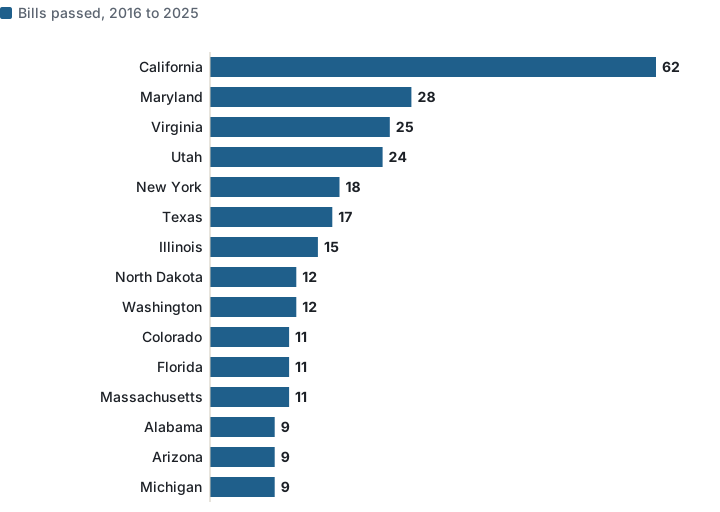
Two counts bear more directly on public bodies. Chapter 3 reports 362 documented AI incidents in 2025, up from 233 in 2024, from the AI Incident Database.[3] Chapter 8 reports that between 2016 and 2025 the United States passed 25 AI-related bills, the most of any G20 country, with South Korea next at 17; that bills passed by U.S. state legislatures rose from fewer than 10 in 2020 to 150 in 2025, with California enacting 20 of the 2025 total; and that AI-related federal regulatory actions rose from one in 2016 to 58 in 2025, 28 of them from the Executive Office of the President.[3]
Limits
The AI Index is a secondary compilation; its policy counts come from the states' own websites and from a keyword search for "artificial intelligence" in final bill texts, so an omnibus bill with several AI provisions counts once, and the report itself warns that volume is not significance.[3] The incident count is the AI Incident Database's, which is updated for past years, so the 2024 figure may differ in a later edition.[3] The benchmark comparison is the report's own scaling and covers tasks that can be scored, not work in an agency.[3]
See also: AI in the public sector, where the federal executive orders are listed from the Federal Register, and AI self-regulation: what happened since for California's 2025 frontier law.
Sources
- Stanford Institute for Human-Centered Artificial Intelligence, The 2024 AI Index Report, key takeaways page. Read 29 October 2026.
- Stanford Institute for Human-Centered Artificial Intelligence, The 2026 AI Index Report, top takeaways page. Read 29 October 2026.
- Stanford Institute for Human-Centered Artificial Intelligence, Artificial Intelligence Index Report 2026 (PDF, 425 pages), April 2026; chapter 2, Technical Performance, chapter 3, Responsible AI, and chapter 8, Policy and Governance (figures 8.4.4, 8.4.5 and 8.4.10). Read 29 October 2026.
How this page was checked: the figures were read from the 2026 report PDF, chapters 2, 3 and 8, and the fifteen state totals were typed from figure 8.4.5 into the CSV beside this page; the 2024 takeaway was read from the 2024 report page. The three documents were read on 29 October 2026.