News follow-up · Energy
The energy use of AI: what happened since
The 2024 post rested on an International Energy Agency forecast. The United States government has since published its own count: data centres used 4.4% of the country's electricity in 2023, and could use between 6.7% and 12% by 2028.
What this site reported
On 6 April 2024 the earlier version of this site reported an International Energy Agency projection that electricity demand from data centres, AI and cryptocurrency could double by 2026, and compared the total with the consumption of a small country.
What the record shows now
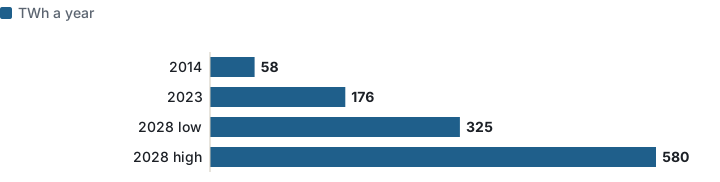
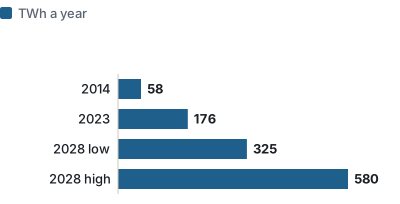
The IEA's reports were not consulted for this page, so it does not repeat or update that forecast; the record used is the U.S. Department of Energy's. The United States record is open. On 20 December 2024 the Department of Energy published a report by Lawrence Berkeley National Laboratory on data centre energy use from 2014 to 2028.[1] The department's summary gives the figures: data centres used about 4.4% of total U.S. electricity in 2023 and are expected to use 6.7% to 12% by 2028; their consumption rose from 58 TWh in 2014 to 176 TWh in 2023, and the report's 2028 range is 325 to 580 TWh.[1]
Federal policy then turned to building more. Executive Order 14318 of 23 July 2025 defines a "Data Center Project" as a facility needing more than 100 megawatts of new load for AI inference, training, simulation or synthetic data generation, and a "Qualifying Project" as, among other cases, one whose sponsor has committed at least $500 million in capital expenditure or one adding more than 100 MW of load.[2] It directs the Secretary of Commerce to launch an initiative of financial support for such projects, "which could include loans and loan guarantees, grants, tax incentives, and offtake agreements", and revokes the January 2025 order on AI infrastructure.[2]
The Energy Information Administration's long-term outlook now separates out servers. Its note of 19 May 2026 on the Annual Energy Outlook 2026, released on 8 April 2026, projects that electricity used by data centre servers alone reaches between 446 and 818 billion kilowatt-hours a year by 2050, depending on the case, with more of the growth in standalone data centres than in server rooms inside other buildings.[3] The outlook assumes server load is flat across the hours of the day, and the agency notes it considers only laws and regulations in place as of December 2025.[3]
Limits
The three documents measure data centres, not AI: the LBNL figures and the EIA projections cover all data centre load, of which AI is an unstated share.[1][3] The 2028 and 2050 figures are projections, and the two series are not comparable, since one counts whole facilities and the other servers only.[1][3] The 2024 post's country comparison is not repeated here because the IEA document it rested on could not be read today.
See also: AI in the public sector for the executive orders on AI.
Sources
- U.S. Department of Energy, news, DOE Releases New Report Evaluating Increase in Electricity Demand from Data Centers, 20 December 2024, announcing the 2024 Report on U.S. Data Center Energy Use by Lawrence Berkeley National Laboratory. Read 29 October 2026.
- Federal Register (govinfo), Executive Order 14318, Accelerating Federal Permitting of Data Center Infrastructure, signed 23 July 2025, published 28 July 2025. Read 29 October 2026.
- U.S. Energy Information Administration, Today in Energy, Data center server energy use grows across the commercial building stock, 19 May 2026, from the Annual Energy Outlook 2026. Read 29 October 2026.
How this page was checked: the four TWh figures were read from the Department of Energy's summary and typed into the CSV beside this page; the LBNL report itself was not consulted; the record used is the department's summary, read on 29 October 2026. The three documents cited were read on 29 October 2026.