Guide · Health
AI in health
What the two federal departments that run and regulate health care say they use AI for, how far along each use is, how many they call high-impact, and how many AI-enabled medical devices the FDA has authorized. Counted from the public record.
What this page counts
Each year federal agencies list their AI use cases, and OMB compiles the lists into one file. The 2025 file holds 3,611 use cases from 41 agency submissions.[1][3] Two of those agencies are the subject here: the Department of Health and Human Services, which the file abbreviates HHS and whose rows name the FDA, CDC, NIH and CMS among its bureaus, and the Department of Veterans Affairs, VA, whose rows are mostly the Veterans Health Administration's.[1] Each row names the bureau or component responsible, so the counts below can go one level down.[2]
The file also files every use case under a topic. "Health and Medical" is one of them, and 272 rows carry it; 166 of those are VA's and 89 are HHS's, so the two departments hold 94% of the government's health-topic AI.[1] The rest sit at Justice with 7, Homeland Security and NASA with 3 each, and one each at four other agencies.[1]
How many
HHS lists 447 use cases, the longest list of any agency in the file, and VA lists 367, the third longest.[1] Together that is 814, or 23% of the inventory. By the stage each department gave:[1]
| Agency | Listed | Deployed | Pilot | Pre-deployment | Retired | High-impact |
|---|---|---|---|---|---|---|
| Department of Health and Human Services (HHS) | 447 | 167 | 88 | 143 | 49 | 2 |
| Department of Veterans Affairs (VA) | 367 | 138 | 21 | 136 | 72 | 215 |
| All 41 agencies | 3,611 | 1,040 | 440 | 1,479 | 314 | 445 |
So 37% of HHS's list and 38% of VA's is marked deployed, against 29% for the whole file.[1] Both departments also kept retired use cases on their lists, 49 at HHS and 72 at VA; every retired row at both carries no topic and no type of AI, which is why "no topic given" appears in the tables below.[1]
Data: hhs-va-by-stage-2025.csv · health-topic-by-agency-2025.csv
Inside HHS
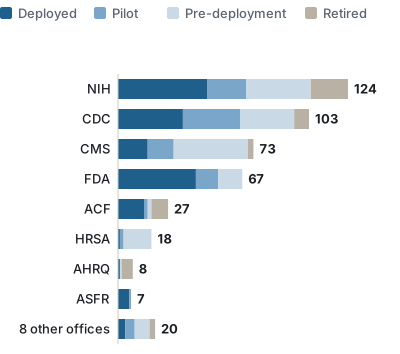
HHS's rows name 16 bureaus and offices. The National Institutes of Health lists 124, the Centers for Disease Control and Prevention 103, the Centers for Medicare and Medicaid Services 73 across its offices, and the Food and Drug Administration 67 across its centers.[1] The FDA list is the furthest along: 42 of its 67 are deployed and none is retired, while CMS has 40 of 73 still before deployment.[1]
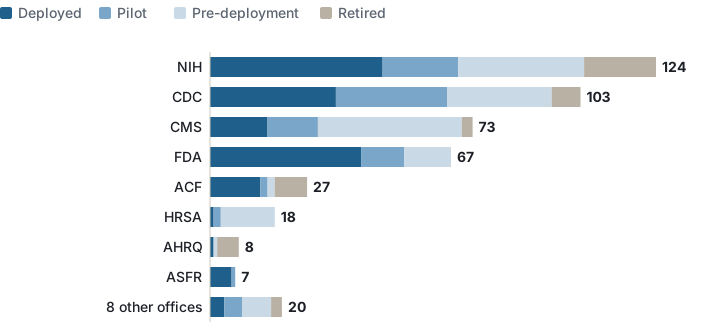
| Bureau | Listed | Deployed | Pilot | Pre-deployment | Retired | Topic: health and medical |
|---|---|---|---|---|---|---|
| HHS/NIH | 124 | 48 | 21 | 35 | 20 | 1 |
| HHS/CDC | 103 | 35 | 31 | 29 | 8 | 32 |
| HHS/CMS | 73 | 16 | 14 | 40 | 3 | 3 |
| HHS/FDA | 67 | 42 | 12 | 13 | 0 | 49 |
| HHS/ACF | 27 | 14 | 2 | 2 | 9 | 0 |
| HHS/HRSA | 18 | 1 | 2 | 15 | 0 | 2 |
| HHS/AHRQ | 8 | 1 | 0 | 1 | 6 | 0 |
| HHS/ASFR | 7 | 6 | 1 | 0 | 0 | 0 |
| 8 other offices | 20 | 4 | 5 | 8 | 3 | 2 |
The topic column says something the bureau names do not. Only 1 of NIH's 124 use cases is filed under health and medical; most are administrative or scientific.[1] At the FDA it is 49 of 67.[1] Among the FDA's named uses are a "Drug Shortage Predictive Model", a pilot at the Center for Drug Evaluation and Research, and the "Elsa GenAI Chat Tool", marked deployed with an operational date of "Jun-25".[1] The FDA announced Elsa on 2 June 2025 as a large language model tool for reading, writing and summarizing, said its models "do not train on data submitted by regulated industry", and said it was already used to "identify high-priority inspection targets".[6]
Inside VA
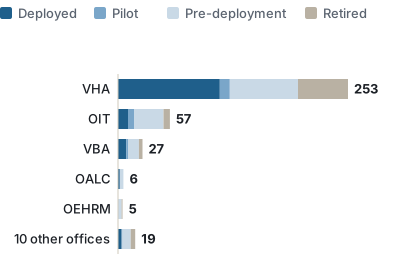
VA's rows name 15 components. The Veterans Health Administration lists 253, 69% of the department's total, with 112 deployed; the Office of Information and Technology lists 57 and the Veterans Benefits Administration 27.[1]
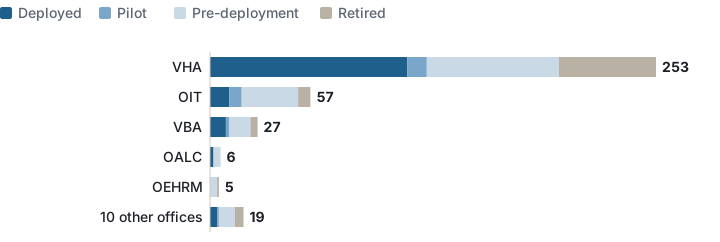
VA's own inventory page gives the same count, 367 use cases in its individual inventory, plus 13 in a consolidated inventory of widely used tools, and says the inventory stands as of December 2025, updated in April 2026.[4] The page names a few of them. "VA GPT", a generative AI chat tool for staff, which the file marks deployed, had "over 95,000 users onboarded" according to VA.[4][1] The "Stratification Tool for Opioid Risk Mitigation (STORM)" is a deployed, high-impact clinical decision support tool for patients prescribed opioids.[1][4] And the file lists computer-vision devices by product name, among them "Computer Aided Detection (CADe) of Neoplasia during Colonoscopy - “GI Genius”", for which VA reports a study showing "a statistically significant 21% increase in the odds of adenoma detection".[1][4]
What the uses are for
By topic, the two departments look different. At HHS the largest group is administrative functions with 117, then health and medical with 89, IT with 87 and science with 48.[1] At VA health and medical leads with 166, then benefits processing with 27 and administrative functions with 25.[1]
| Topic | HHS | VA | Both |
|---|---|---|---|
| Health and Medical | 89 | 166 | 255 |
| Admin Functions | 117 | 25 | 142 |
| (no topic given) | 49 | 72 | 121 |
| IT | 87 | 18 | 105 |
| Science | 48 | 2 | 50 |
| Benefits Processing | 5 | 27 | 32 |
| Service Delivery | 18 | 12 | 30 |
| Other | 11 | 12 | 23 |
| Procurement and Finance Mgmt | 7 | 12 | 19 |
| Cybersecurity | 1 | 9 | 10 |
| HR | 3 | 7 | 10 |
| Law Enforcement | 4 | 5 | 9 |
| Emergency Mgmt | 8 | 0 | 8 |
The type of AI differs too. HHS chose generative AI for 140 use cases and language processing for 117; VA's largest label is computer vision with 81, of which 77 are VHA's, then classical machine learning with 76.[1] Named examples from the file: at CDC, "MedCoder - Coding literal text cause of death information reported on death certificates to ICD-10" and "Short-term Forecasting of Severe Outcomes for Seasonal and Epidemic Pathogens", both deployed; at CMS, an "Independent Dispute Resolution (IDR) Eligibility Rules Engine", deployed; at VBA, the "Payment Redirect Fraud (PRF) Model", deployed and high-impact, which VA says refers suspect direct-deposit changes to investigators.[1][4]
Data: hhs-va-by-topic-2025.csv · hhs-va-by-classification-2025.csv · examples-2025.csv
High-impact uses
OMB's term for AI whose output is a principal basis for decisions with a legal, material or significant effect on rights or safety is "high-impact", and each agency decides which of its uses qualify.[2] VA marked 215 of its 367 use cases high-impact, which is 48% of the 445 high-impact use cases in the whole file.[1] HHS marked 2 of 447: "Unaccompanied Child Sponsor Identity Verification" at the Administration for Children and Families and "iVeri-Fi (Test)" at CMS, both before deployment; 13 more were presumed high-impact and then determined not to be.[1]
Of VA's 215, 172 are at VHA and 132 carry the health and medical topic.[1] VA says it "has not granted any waivers" from the minimum risk management practices required for high-impact AI use cases.[4] On the gap between the two departments, the file records the label, not the reasoning.
AI-enabled medical devices
The other public count in federal health AI is the FDA's list of AI-enabled medical devices authorized for marketing in the United States. The CSV behind the page, marked current as of 4 September 2026, holds 1,614 entries, the latest with a final decision dated 29 June 2026.[5] The FDA says the list "is not a comprehensive resource" and that devices were identified "primarily based on the use of AI-related terms in the summary descriptions" of their authorization documents.[5]
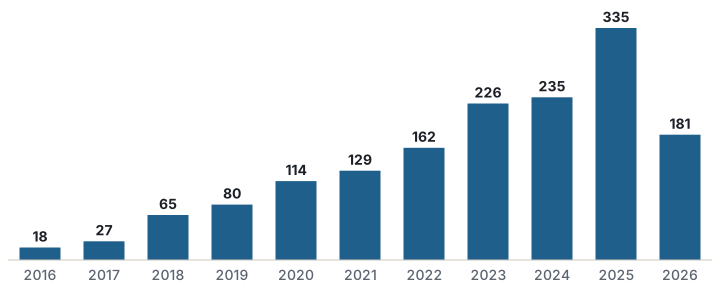
The count by year of decision rose from 18 in 2016 to 114 in 2020 and 335 in 2025, with 181 in the first half of 2026.[5] Radiology is the lead review panel for 1,230 entries, 76% of the list; cardiovascular is next with 154 and neurology with 73.[5] The two counts meet at VHA, whose inventory rows include authorized imaging products by name.[1]
Data: fda-ai-enabled-devices-by-panel.csv
The earlier version of this site ran posts on AI in radiology, pathology, surgery, optometry, drug discovery and the health workforce. They are replaced by this page, which counts what the agencies themselves have put on the record.
Counting caveats
- Agencies report on themselves, and each chose its own stage, topic, type of AI and high-impact label.[2]
- The inventory leaves out AI in national security systems, AI used for basic or applied research, and Department of War use cases (the Department of Defense, under the name OMB's file uses), so military health care is not in these counts. Common tasks done with off-the-shelf products go in a separate consolidated file.[3]
- A bureau's count is a count of what it reported. NIH's 124 and VHA's 253 include retired rows, 20 and 55.[1]
- The FDA list counts marketing authorizations whose public summaries use AI terms, not devices in use.[5]
See also: AI in the public sector for the whole inventory, Generative AI in government, Data science in government, and the data story 3,611 uses of AI on the federal list.
Sources
- Office of Management and Budget, 2025 Federal Agency AI Use Case Inventory, file of individually reported use cases (3,611 rows; the repository says "as of April 13, 2026"), counted by this site: 2025_individually_reported_AI_use_cases.csv. Read 28 October 2026.
- Office of Management and Budget, 2025 inventory data dictionary. Read 28 October 2026.
- Office of Management and Budget, 2025 Federal Agency AI Use Case Inventory repository, README (summary, submission schedule and exclusion criteria). Read 28 October 2026.
- U.S. Department of Veterans Affairs, AI Use Case Inventory page (inventory "as of December 2025, updated April 2026"; page modified 1 September 2026). Read 29 October 2026.
- U.S. Food and Drug Administration, List of Artificial Intelligence-Enabled Medical Devices (page marked "content current as of" 4 September 2026) and its CSV download (1,614 rows), counted by this site. Read 29 October 2026.
- U.S. Food and Drug Administration, news release, FDA Launches Agency-Wide AI Tool to Optimize Performance for the American People, 2 June 2025. Read 29 October 2026.
How this page was counted: one row per use case in OMB's file, read on 28 October 2026, by the agency, agency_bureau (HHS: the first two segments split on "/"; VA: the text before the colon), development_stage, is_high_impact, topic_area and classification columns, with blanks counted as "no stage given", "no topic given" or "no classification given"; and one row per entry in the FDA's CSV of AI-enabled medical devices, read on 29 October 2026, by the year in Date of Final Decision and by Panel (Lead). The CSV files beside this page carry the counts, the rules in README.txt, the source addresses and the read dates.